
GoHaych journal
Outsource Operations: What SMEs Can Move Outside the Business First
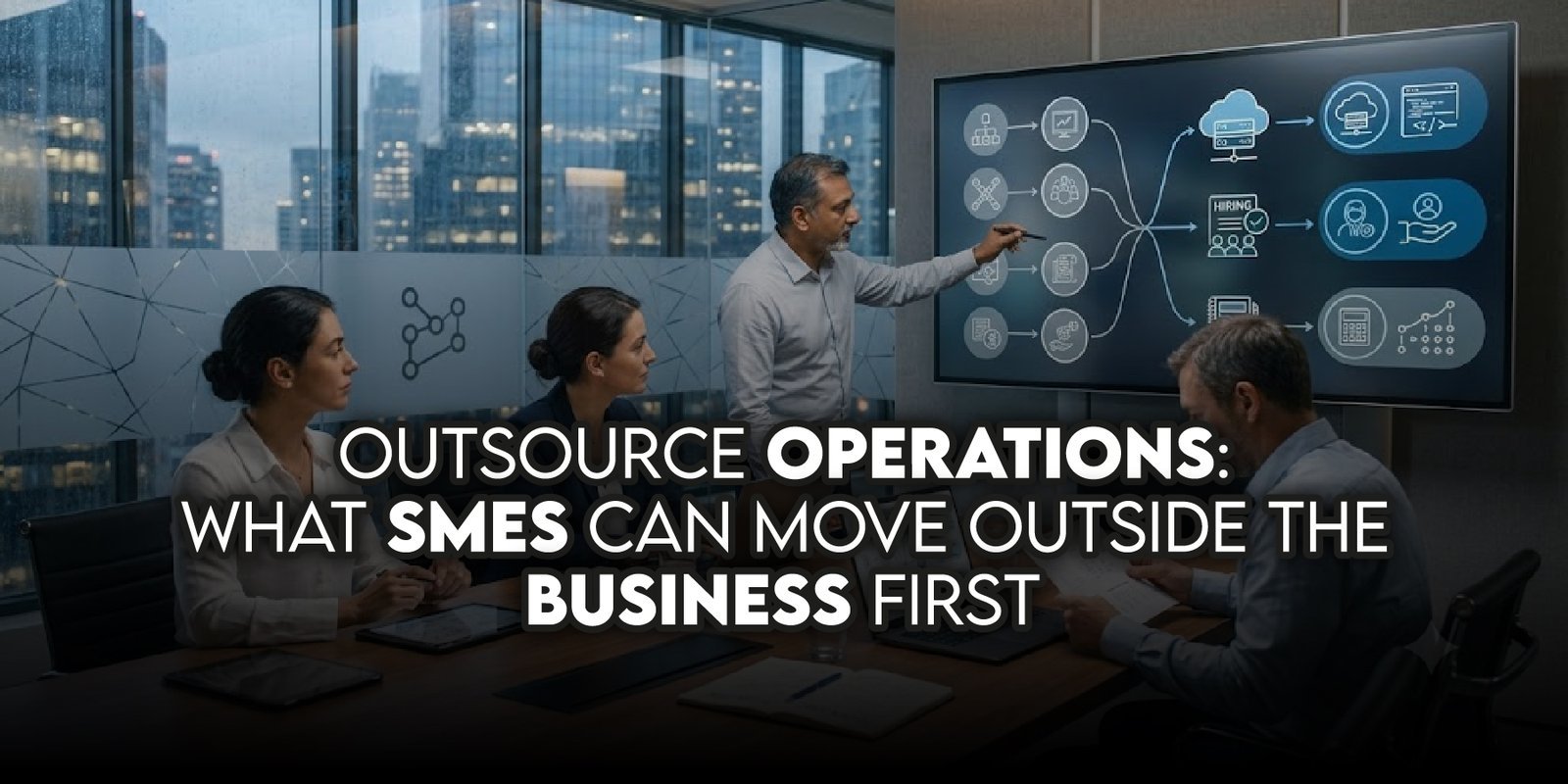
A small internal team spends valuable hours updating CRM records, answering routine IT requests, preparing reports, organising admin and following up repeat processes. Nobody is failing, but too much attention sits inside repeatable work.
This is often the moment to outsource operations carefully. The question is not “what can we hand away today?” It is “which process is repeatable, documentable, measurable and suitable for external support first?”
GoHaych supports IT and Business Process Outsourcing across services including IT support, developer services, cloud, ERP, AI and data analytics, e-commerce, digital marketing, customer service, HR, admin support, procurement, accounting and finance, and graphic design.
What Does It Mean to Outsource Operations?
To outsource operations means assigning defined operational activities to an external provider, remote professional or outsourced support team while the business keeps strategy, standards, approvals and final accountability internal. The best first step is not blind delegation. It is controlled operational handover.
For SMEs, outsource operations decisions should begin with process clarity. A business should know the trigger, input, task, output, owner and approval point before moving the work outside the internal team.
This matters because external support can only deliver consistently when the business explains what good work looks like. For this reason, outsource operations planning should start with process design.
What Operations Should SMEs Outsource First?
SMEs should usually start with repetitive, process-led, time-consuming and measurable tasks that do not depend on constant strategic judgement. Good first candidates include admin support, routine IT support, CRM updates, reporting, customer-service triage, data processing and structured follow-up work.
This is the safest way to outsource operations because the work is easier to document and review. However, strategy, pricing, high-risk approvals and sensitive commercial judgement should normally stay close to leadership.
When SMEs outsource operations in stages, they learn what works before expanding the arrangement. That makes outsource operations decisions easier to defend internally.
Look for Tasks That Consume Time but Not Strategy
The best starting tasks often consume attention without requiring senior decision-making. A practical outsource operations plan begins with those hidden workload leaks.
For example, CRM updates, spreadsheet management, file organisation, report formatting and routine customer follow-ups can become daily pressure points.
However, important work is not always strategic work. A weekly report may be valuable, but that does not mean a director must build it manually every time.
Therefore, SMEs should outsource operations by identifying work that repeats often, follows rules and can be checked against a clear output.
Use a Simple Outsourcing Suitability Score
A scoring model helps SMEs compare tasks before choosing what to outsource first. Instead of relying on gut feeling, score each process by repetition, documentation, judgement, sensitivity, skill and measurability.
| Factor | Low Suitability | Medium Suitability | High Suitability |
|---|---|---|---|
| Repetition | Rare task | Monthly task | Weekly or daily task |
| Documentation | No process | Some notes | Clear checklist or SOP |
| Strategic importance | Board-level decision | Mixed judgement | Operational execution |
| Need for judgement | Constant judgement | Some judgement | Rule-based decisions |
| Skill requirement | Very specialist | Moderate skill | Defined capability |
| Volume | Low volume | Occasional pressure | Regular workload |
| Measurability | Hard to check | Partly measurable | Clear output |
| Data sensitivity | Highly sensitive | Controlled access | Limited access |
| Task | Suitability Score | Why |
|---|---|---|
| CRM record updates | High | Repetitive, measurable and process-led |
| Weekly report formatting | High | Clear output and deadline |
| Pricing strategy | Low | Requires commercial judgement |
| Routine IT access requests | Medium to high | Suitable if permissions are controlled |
| Customer enquiry triage | Medium | Works with scripts and escalation |
| Product roadmap decisions | Low | Strategic ownership should stay internal |
This table gives a practical way to outsource operations without moving the wrong work too early. It also shows why outsource operations scoring should include risk, not only time pressure.
Operations Outsourcing: Start With Repeatable Processes
Operations outsourcing works best when SMEs begin with repeatable processes rather than vague job titles. A process has a trigger, steps, output and review point. A job title can hide too many assumptions.
For example, “admin help” is unclear. Meanwhile, “weekly CRM clean-up, invoice-data preparation and report formatting” is easier to brief and measure.
Because repeatable work creates clearer expectations, SMEs can outsource operations with less confusion and better visibility. The first outsource operations project should prove the process before expanding scope.
Administrative Operations SMEs Can Outsource
Administrative tasks are often strong early candidates because they create recurring friction. SMEs may review data entry, CRM maintenance, calendar administration, document formatting, spreadsheet work, routine reporting, inbox administration, scheduling, task follow-ups and file organisation.
GoHaych offers admin support within its full-time outsourcing service categories, alongside other operational functions. Its admin support content also describes delegated administrative tasks such as scheduling, data entry and customer support.
Before SMEs outsource operations in admin, they should define what the external person can action independently and what still needs approval. Clear limits make outsource operations support easier to supervise.
Outsourced IT Operations
Outsourced IT operations may include routine IT support, user support, cloud administration where appropriate, ERP support, website maintenance, development work, technical documentation and defined technical projects. The exact scope should match the systems and risks involved.
GoHaych lists IT Services & Support, ERP, cloud computing, AI and data analytics, developer services and e-commerce services across its outsourcing pages. Its project-based services also include IT support, SAP support, ERP, digital marketing, customer service, HR and accounting or finance services.
When SMEs outsource operations in IT, access control matters. Technical execution can be external, but high-risk permissions and final decisions should stay with accountable internal leaders.
Which IT Work Should Stay Internal?
Some IT work may need internal ownership, even when specialist execution comes from outside. Technology strategy, final architecture decisions, critical vendor choices, high-risk permissions, major system changes and sensitive commercial decisions usually need senior internal accountability.
However, keeping ownership internal does not prevent external delivery. For example, a provider can help maintain a website, support ERP tasks or deliver development work while the business approves priorities.
This balance helps SMEs outsource operations without losing control of technical direction. It also keeps outsource operations decisions aligned with business risk.
Customer Service and Sales Support
Customer service and sales support may suit outsourcing when the task is structured. Examples include first-line enquiry handling, lead qualification, CRM updates, follow-up administration and routine customer communication.
However, scripts, tone, escalation rules and approval boundaries should be clear. For example, an outsourced support team may triage enquiries, but sensitive complaints or commercial decisions may need internal review.
For this reason, SMEs should outsource operations in customer-facing work only after they define brand voice and escalation routes. Good outsource operations planning protects customer experience as well as workload capacity.
Finance and Accounting Support
Finance and accounting support can include bookkeeping support, reporting assistance, invoice administration, data preparation and reconciliation support where appropriate. GoHaych lists accounting and finance services within its full-time outsourcing categories and project-based service options.
However, final financial decisions, tax advice, legal interpretation and senior finance ownership may require internal leaders or qualified professional advice. This article does not provide financial advice.
When SMEs outsource operations linked to finance, they should define approval limits, access permissions and review checkpoints carefully. A cautious outsource operations model keeps final financial judgement internal.
HR and Recruitment Administration
HR and recruitment administration may include interview scheduling, candidate administration, recruitment coordination, record organisation and routine HR support. These tasks can create pressure when hiring increases or internal managers already carry too much admin.
However, final hiring decisions, sensitive employee matters and policy decisions often require internal ownership. External support can help organise the process, but leadership should keep judgement where risk is higher.
This distinction helps SMEs outsource operations without weakening accountability. It also keeps outsource operations support focused on administration rather than sensitive decisions.
Procurement and Supply-Chain Administration
Procurement administration may include supplier information, purchase administration, tracking, documentation, reporting and routine follow-up work. GoHaych includes procurement and supply-chain management among its full-time outsourcing service categories.
However, supplier strategy, major contract decisions, high-value approvals and commercial negotiation should usually remain internally controlled. External support can organise data and process steps while leaders make decisions.
Therefore, SMEs can outsource operations in procurement when the task is process-led and approval rules are clear. The same outsource operations principle applies to other back-office workflows.
E-Commerce Operations
E-commerce operations often contain repeatable tasks. Product-data updates, order administration, customer enquiries, catalogue maintenance, store support, reporting and content upload can all create pressure.
GoHaych lists e-commerce services as part of its outsourcing offer. Depending on scope, an outsourced support team may help with store administration or defined digital tasks.
Before SMEs outsource operations in e-commerce, they should document product rules, approval points, platform access and customer escalation steps. This keeps outsource operations activity visible inside the store workflow.
Marketing Execution
Marketing execution may include SEO implementation, content production, social-media scheduling, graphic design, paid-ad execution and reporting. However, marketing strategy, brand direction and major budget decisions should stay internally owned.
GoHaych lists digital marketing and graphic design among its outsourcing service areas. Project-based outsourcing may also fit defined campaigns, website tasks or content projects.
In practice, SMEs outsource operations in marketing most effectively when they separate strategy from execution. A focused outsource operations brief should state who approves campaigns and budgets.
What Should SMEs Usually Keep In-House?
SMEs should usually keep core strategy, final pricing, product direction, major financial decisions, high-level customer relationships, final hiring decisions, sensitive commercial judgement and core intellectual property decisions close to the business.
This is not an absolute rule for every company. However, outsource operations decisions become safer when ownership is reviewed before handover.
The key question is simple. Does the task need judgement that shapes the business, or is it defined execution that supports the business?
| Keep Closer In-House | May Suit External Execution | Why |
|---|---|---|
| Pricing strategy | Pricing research support | Final judgement remains internal |
| Product direction | Product data updates | Strategy and admin differ |
| Key client relationships | Follow-up administration | Sensitive relationships need ownership |
| Final hiring decisions | Interview scheduling | Coordination can be delegated |
| Major financial decisions | Invoice-data preparation | Approval must stay controlled |
| Core brand positioning | Design or content execution | Direction and delivery differ |
Business Process Outsourcing: Think in Processes, Not Job Titles
Business process outsourcing works better when SMEs describe the process, not just the role. “Outsource our admin” is weaker than “outsource weekly CRM clean-up, monthly reporting and invoice-data preparation.”
A process-led brief improves clarity because it defines what happens, when it happens and what output should appear. It also makes quality easier to review.
Therefore, businesses that outsource operations should build around workflows, not loose job descriptions. This is where outsource operations becomes an operating-system decision, not a staffing shortcut.
Map the Process Before You Outsource It
A basic process map can be enough for a first handover. Use this structure:
Trigger → Input → Task → Approval → Output → Exception → Report
For example, a customer enquiry process may start with an email, move to classification, require a CRM update, need escalation for complex issues and finish with a daily summary.
This type of map helps an outsourced support team work without asking for direction at every step.
Document the Minimum Useful SOP
SMEs do not need a 100-page manual before using external support. However, they do need a minimum useful SOP that explains purpose, trigger, steps, tools, expected output, deadline, approval point and exception route.
For example, a reporting SOP may include where data comes from, how it should be formatted, when it is due and who approves it.
Good documentation helps SMEs outsource operations with fewer avoidable questions. It also makes outsource operations easier to review after the first month.
Outsourced Support Team vs Individual Specialist
An individual specialist may suit a narrow skill requirement, defined responsibility or smaller workload. An outsourced support team may suit several processes, mixed skills, ongoing delivery or more complex operational support.
Neither option is automatically better. The right choice depends on volume, skill mix, continuity, management time and process maturity.
When SMEs outsource operations, they should choose the structure that fits the work, not the label. The best outsource operations model reflects workload volume and skill mix.
Project-Based vs Ongoing Outsourcing
Project-based outsourcing suits defined work with a start and finish. Ongoing outsourcing suits recurring work that needs regular support, continuity and process familiarity.
| Factor | Project-Based | Ongoing Outsourcing |
|---|---|---|
| Best for | Defined task or project | Recurring operational workload |
| Duration | Limited period | Continuing requirement |
| Workload | Fixed deliverables | Repeatable tasks |
| Continuity | Less central | More important |
| Management | Milestones and scope | Reporting and rhythm |
| Example | Website update or ERP task | Admin, IT support or reporting |
GoHaych offers both full-time outsourcing and project-based outsourcing models. Therefore, businesses can discuss whether a defined project or ongoing support better fits the work.
Outsourcing for Startups vs Established SMEs
Startups often use outsourcing to protect founder time and avoid building departments too early. Established SMEs may focus more on operational capacity, specialist skills, process consistency and scaling support.
GoHaych’s outsourcing strategy for startups explains that early-stage companies should move from reactive delegation to deliberate operating design. It also highlights repeatable work such as inbox support, scheduling, reporting, bookkeeping support, CRM updates and routine marketing execution.
Although this article focuses on SMEs, the same principle applies. The first outsource operations move should be repeatable, not strategically fragile.
Start With One Process, Not Five Departments
A controlled first phase is usually easier to manage. Instead of moving admin, IT, marketing, finance and customer support at once, start with one process such as CRM administration plus reporting.
This makes ownership clearer. It also makes quality review easier because the business can identify whether problems come from the brief, workflow, access or provider.
For SMEs that outsource operations for the first time, the first process becomes the learning ground. That first outsource operations phase should stay narrow enough to review properly.
Define an Internal Process Owner
Even when SMEs outsource operations, someone internally should own priorities, quality, approvals, exceptions, process changes and escalation. Internal ownership is what makes outsource operations manageable.
The process owner does not need to perform every task. Instead, they keep the brief clear, review outputs and decide when the process changes.
This protects accountability while external support handles execution.
Set Clear Outputs
Clear outputs make outsourcing easier to measure. “Help with customer service” is vague. “Handle first-line email enquiries using approved guidance, update the CRM and escalate billing complaints” is clearer.
Likewise, “support marketing” is weak. “Schedule approved social posts, update the tracker and prepare the weekly performance summary” gives a reviewable output.
When SMEs outsource operations, output clarity reduces rework and confusion. It also helps the outsource operations provider understand the expected finish line.
Measure Outcomes
SMEs should measure outsourced work through completion rate, backlog, error or revision rate, task turnaround against agreed expectations, customer satisfaction where relevant, documentation completeness and escalation count.
Do not copy generic benchmarks. A good KPI for admin support may not suit developer services or customer-service triage.
Instead, build measurements around the output. This makes operations outsourcing easier to review without micromanaging every action. In addition, outsource operations reviews should focus on outputs, errors and blockers.
| KPI | What It Measures | Useful For |
|---|---|---|
| Completion rate | Whether agreed tasks finish | Admin, support, reporting |
| Backlog | Work waiting to be completed | IT, customer support, CRM tasks |
| Error or revision rate | Quality issues | Data, content, reporting |
| Turnaround against agreed expectations | Delivery rhythm | Recurring operational work |
| Escalation count | Work needing internal judgement | Customer support, finance admin |
| Documentation completeness | Process maturity | BPO and technical support |
How to Build a Remote Team That Can Deliver the Work
Remote delivery works better when businesses define roles, communication, ownership, workflow, documentation and performance expectations. GoHaych’s guide on how to build a remote team that performs explains that remote teams need clear roles, communication routines, accountability, performance metrics, onboarding, documentation and collaboration tools.
This matters when an SME wants more than one external specialist. In that case, the company needs a management structure as well as task coverage.
For more detailed planning, the remote-team performance framework can support the next stage after the first outsourced process is stable.
How Gohaych Supports Outsourced Operations
At GoHaych, we support businesses that want to move defined IT, administrative and business-process work outside the internal team. Current service categories include IT Services & Support, Admin Support, Developer Services, Cloud Computing, ERP, AI and Data Analytics, E-Commerce, Customer Service and Sales, HR, Accounting and Finance, Procurement, Digital Marketing and Graphic Design.
Our team can review workload, processes, required skills and engagement type before discussing suitable support. Some requirements may suit a dedicated ongoing resource, while others may fit a defined project model.
When SMEs outsource operations with GoHaych, the starting point should be scope clarity rather than a generic service request. That keeps outsource operations discussions tied to real workload.
Discuss Which Operations Could Move Outside Your Business
SMEs can share current workload, repetitive processes, IT requirements, admin requirements, required skills, internal capacity and ongoing or project needs with GoHaych.
To begin the discussion, request an outsourcing quote with the processes you are considering for external support.
A Practical 30-Day First-Outsourcing Plan
A 30-day plan is only an example framework, not a fixed transition rule. However, it shows how to outsource operations without moving everything at once.
| Period | Focus | Practical Action |
|---|---|---|
| Week 1 | Audit | List workload, repeated tasks and bottlenecks |
| Week 2 | Document | Create SOPs, outputs and approval points |
| Week 3 | Start | Move one process to external support |
| Week 4 | Review | Check quality, communication and process gaps |
After the first review, decide whether to refine, pause or expand.
For startups, the step-by-step startup outsourcing plan can support a similar staged approach.
When to Expand the Outsourced Scope
Expand only when the process is stable, output meets agreed standards, documentation works, internal ownership is clear and new recurring workload appears. A suitable commercial model also matters.
However, more external support will not fix a weak process. If instructions remain unclear, expansion can create more confusion.
Therefore, SMEs should outsource operations gradually and review each phase before adding the next function. This protects the outsource operations model from uncontrolled expansion.
When Not to Expand
Do not expand outsourcing when documentation is poor, quality issues remain unresolved, instructions keep changing, sensitive work lacks governance, no internal owner exists or the commercial model no longer fits.
In addition, do not outsource operations simply because the team feels busy. A good outsource operations decision follows process evidence.
Outsourcing should support better operations, not hide poor process design.
Common Mistakes When SMEs Outsource Operations
Common mistakes include outsourcing strategic decisions first, moving unclear processes externally, assigning no process owner and creating no documentation.
Other mistakes include outsourcing too many areas at once, choosing only by price, setting no KPIs, using weak communication and creating no escalation rules.
In addition, SMEs often grant excessive permissions, onboard poorly, skip quality review, ignore handover and assume every function should move outside the business.
Outsource Operations Checklist
Use this outsource operations checklist before moving work outside the business:
- Audit current workload.
- List repetitive tasks.
- Identify internal bottlenecks.
- Separate strategic from operational work.
- Score outsourcing suitability.
- Pick one starting process.
- Document the workflow.
- Define the output.
- Define the approval point.
- Assign an internal owner.
- Select the required skill.
- Choose project or ongoing support.
- Define communication.
- Set permissions.
- Set KPIs.
- Create escalation rules.
- Start with controlled scope.
- Review quality.
- Review workload.
- Record process changes.
- Check documentation.
- Expand only where appropriate.
- Review commercial fit.
- Review the arrangement regularly.
Frequently Asked Questions
What does it mean to outsource operations?
To outsource operations means assigning defined operational activities to an external provider, remote professional or outsourced support team while the business keeps strategy, final decisions, standards and accountability internal. It works best when the task is documented, measurable and suitable for external execution.
What operations should SMEs outsource first?
SMEs should usually start with repetitive, time-consuming, process-led and measurable tasks. Examples include admin support, CRM updates, routine reporting, data entry, customer-service triage and routine IT support. These tasks are often easier to document and review than judgement-heavy strategic work.
What is operations outsourcing?
Operations outsourcing means moving specific operational processes to external support while keeping ownership inside the business. It can include IT support, admin tasks, customer support, reporting, finance administration, HR administration, procurement tasks, e-commerce operations and marketing execution where the scope is clear.
What business processes can be outsourced?
Business processes that may be outsourced include data processing, CRM maintenance, report preparation, inbox administration, customer enquiry triage, product-data updates, first-line IT support, finance administration and marketing execution. However, the best fit depends on process maturity, access needs and internal approval rules.
What is business process outsourcing?
Business process outsourcing is the use of an external provider to carry out defined business processes. For SMEs, business process outsourcing may cover back-office support, customer service, finance administration, HR support, IT support, marketing execution or procurement administration while leaders retain strategic ownership.
What IT operations can be outsourced?
Outsourced IT operations may include routine IT support, user support, website maintenance, cloud support, ERP support, technical documentation, development work and defined technical projects. However, technology strategy, high-risk permissions and major system decisions should normally remain internally owned.
What admin tasks can SMEs outsource?
SMEs can outsource admin tasks such as data entry, CRM updates, calendar management, document formatting, spreadsheet work, routine reporting, inbox administration, scheduling, task follow-ups and file organisation. The business should still define approval points, output standards and escalation rules.
What is an outsourced support team?
An outsourced support team is an external team that handles defined operational work for a business. It may support admin, IT, customer service, e-commerce, finance administration, HR or other business processes. The team should work from clear scope, documentation, reporting and internal ownership.
Which business activities should stay in-house?
Business strategy, final pricing, major financial decisions, product direction, key customer relationships, final hiring decisions, sensitive commercial judgement and core intellectual property decisions should usually stay in-house. External specialists can still support research, admin or execution around those areas.
Should SMEs outsource customer service?
SMEs may outsource customer-service triage, enquiry handling, CRM updates and routine follow-ups when scripts, tone, escalation rules and approval boundaries are clear. However, sensitive complaints, important accounts and commercial decisions may need internal review.
Should SMEs outsource marketing execution?
SMEs can outsource marketing execution such as SEO implementation, social-media scheduling, content production, design, paid-ad execution and reporting. However, brand strategy, positioning, budget decisions and final approvals should usually remain with internal decision-makers.
What is the difference between project-based and ongoing outsourcing?
Project-based outsourcing suits defined work with a clear start, end and deliverable. Ongoing outsourcing suits recurring operational work that needs continuity and regular support. The right choice depends on workload, duration, skill requirements, process maturity and management capacity.
How should SMEs measure outsourced work?
SMEs should measure outsourced work through output quality, completion rate, backlog, error or revision rate, turnaround against agreed expectations, documentation completeness and escalation count. KPIs should reflect the actual function rather than generic performance claims.
How should startups approach outsourcing?
Startups should approach outsourcing by protecting founder time, starting with repeatable tasks, documenting processes and keeping strategy internal. They should avoid random delegation and build a staged operating model that fits their growth stage, cash position and management capacity.
How can GoHaych support outsourced operations?
GoHaych can discuss outsourced operations across IT, admin, BPO, development, cloud, ERP, AI and data, e-commerce, customer service, HR, finance, procurement, marketing and design. The right model depends on workload, required skill, process maturity, duration and engagement type.
Conclusion
When SMEs outsource operations, they should begin with workload pressure, not a generic desire to delegate. The strongest first candidates are repeatable, process-led, measurable and time-consuming tasks that do not require constant strategic judgement.
Keep strategy, approvals and sensitive decisions internal. Then document the process, assign ownership, choose the right engagement model, measure outputs and review quality before expanding.
Ultimately, the best way to outsource operations is to start small, learn quickly and move only the right work outside the business.
Plan the Right Outsourcing Mix for Your Business
SMEs can share current operational workload, IT needs, admin requirements, business processes, skills required and preferred engagement model with GoHaych to discuss suitable outsourcing support.
To review the right model for your business, get a quote for outsourced operational support